

Burning Bush Blogs
Equipping Believers with Biblical Knowledge and Leadership Skills
Category: Personal Study
Thread: Game of Thrones
Post Topic: When earth met heaven: Dedication of the Glorious Temple
(Three-day Study)
Post in Thread: #29
Previous: King Solomon Becomes the Wisest Man Ever
Next: King Solomon Makes a Believer out of the Queen
Scripture: Multiple (see each day’s study individually)
Background
God never allowed King David to build the Holy Temple because David was a man of violence and war. Although known for killing the Philistine giant Goliath, that feat only scratched the surface of his military exploits. His wars ranged from external foes like the Philistines and Amorites to internal foes like civil wars against the House of Saul and a revolt led by his own son, Absalom.
Solomon, David’s successor, reigned over a kingdom of peace. In I Chronicles 22:7-10, David explains to Solomon that God wanted a peaceful king to build his holy temple, and Solomon would be the man for the job.
This post is written in 3 parts. We recommend studying each part individually rather than attempting to digest everything in one sitting. The first part describes the magnificent temple, while the last 2 parts focus on the dedication of the temple, when the glory of the Lord filled every corner.
Part I – Building God’s Magnificent Holy Dwelling Place – Where Does He Dwell Today?
Note – this is part 1 of a 3-part study of the building and dedication of the holy temple. We suggest reading each part as a single day’s Bible study.
Imagine
The quarry team strained with the ropes and pulleys. The men’s grunts drowned out the incessant cries of the crows in the trees around them. Arnad studied the boulder from above, waiting patiently for them to force it over the top of the ramp. Then the mules could drag it away to the masons’ camp. It was the largest they’d extracted in a week, but it had a blemish on one side. The masons would have to chip that away…
A massive heave, and the boulder teetered on the edge. Arnad dropped the plans and rushed in to help. A final huge push, and it thudded onto the pathway. Sweaty men collapsed all around Arnad. They let loose a thunderous cheer as they tumbled to the ground, scaring away the infernal crows.
Wordlessly, he picked the scroll back up and brushed off the dirt. Normally he didn’t get involved with the manual labor, but he hadn’t wanted the stone to roll back down.
Arnad circled the boulder, imagining it smoothed out, with the blemish chipped away. Excitedly, he went back to the plans. Yes, this was the one! He’d finally found the northeast cornerstone!
Joash sidled up beside him. “I know that expression! Is this it? Solomon will be pleased.”
Arnad ran his hand along the shiny white side of the boulder where they’d chiseled it free. Already, it was smooth. But strong.
“More importantly,” Arnad said, “The Lord will be pleased.”
Scripture
Passage: I Kings 6:1-38
Key Verses (but read entire passage):
In the four hundred and eightieth year after the Israelites came out of Egypt, in the fourth year of Solomon’s reign over Israel, in the month of Ziv, the second month, he began to build the temple of the Lord.
I Kings 6:1; I Kings 6:7; I Kings 6:19; I Kings 6:27-28; I Kings 6:37-38
…
7 In building the temple, only blocks dressed at the quarry were used, and no hammer, chisel or any other iron tool was heard at the temple site while it was being built.
…
19 He prepared the inner sanctuary within the temple to set the ark of the covenant of the Lord there.
…
27 He placed the cherubim inside the innermost room of the temple, with their wings spread out. The wing of one cherub touched one wall, while the wing of the other touched the other wall, and their wings touched each other in the middle of the room. 28 He overlaid the cherubim with gold.
…
37 The foundation of the temple of the Lord was laid in the fourth year, in the month of Ziv. 38 In the eleventh year in the month of Bul, the eighth month, the temple was finished in all its details according to its specifications. He had spent seven years building it.
Observations
Context
Solomon has been king for four years. In previous chapters, King David had begun planning for God’s temple, but the actual building of the temple was reserved for Solomon, a man of peace and prosperity. David set aside massive funds from his personal wealth to be used by Solomon for the project.
In the previous chapter, I Kings 5, Solomon began preparing for building the temple. He sub-contracted with Hiram, King of Tyre, who was friendly to Solomon’s father. Solomon also hired thousands of skilled laborers from his people. Together, the stone masons and wood cutters began preparing the materials for construction.
Building the Temple
- An exact time frame is given for the start of the project: 480 years after the people left Egypt.
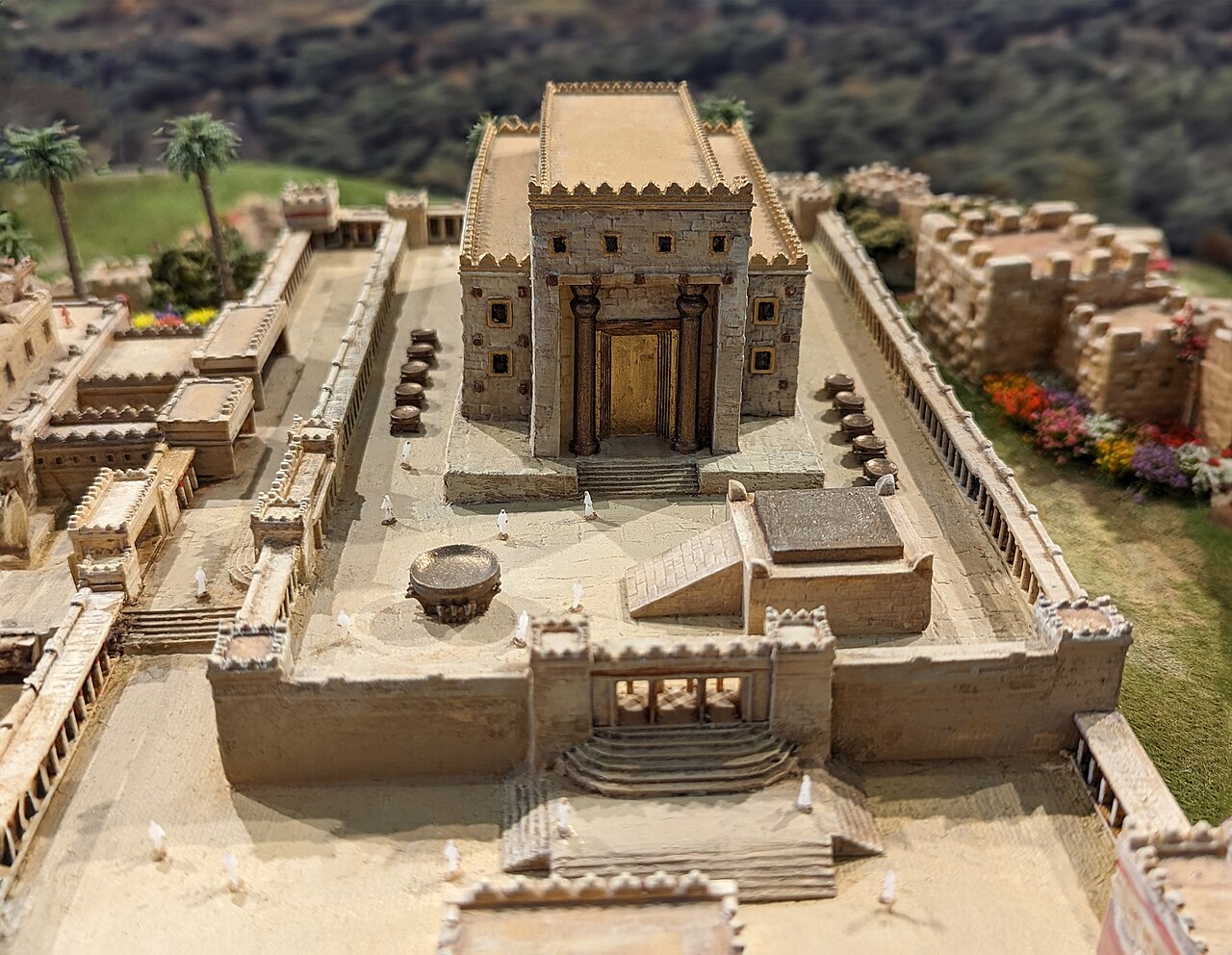
- The size of the temple was about 90 feet long by 30 feet wide by 45 feet tall. Most dimensions were double the size of the portable tabernacle that Moses and the people carried through the wilderness.
- No hammer or chisel or tool of iron was used on temple grounds. Everything was cut and measured and prepared offsite.
- No stone was visible inside – everything was covered by cedar.
- The temple took seven years to build.
The Inner Sanctum
- The inner sanctum was an especially holy place, to be reserved for the ark.
- All the cedar in this inner sanctum was overlaid with gold.
- Two massive cherubim figures were built, with wings outstretched.
- The cherubim were built exactly the right size so that when their wings touched in the center, their outer wings both stretched to the walls of the inner sanctum. In other words, the pair’s open wings stretched all the way across from one wall to the other.
Interpretation
Setting
Solomon’s temple was built on Mt. Moriah in Jerusalem. It is here where:
- Abraham was told to sacrifice his son, Isaac, before God stopped him at the last moment.
- Solomon’s temple was built. It stood for 400 years before the Babylonians destroyed it.
- The 2nd temple was built on the same spot after 70 years in exile. King Herod expanded the temple into what it was during the time of Christ. Herod’s project started about around 20BC. The Romans destroyed this temple in 70AD.
- Jesus was crucified outside the city walls, but within view of Mt. Moriah and the rebuilt temple.
- Today, the Dome of the Rock stands on this site.
To Ponder
As we read of the magnificence of the temple, it begs the question – should our churches today be built with similar grandeur? There are many spectacular churches in Europe that are beautiful to tour, but are mostly empty or not used at all on Sundays. One could argue that the beauty draws common folks closer to God, and is done in reverence to him. The counter-argument would be that the money could and should be spent on better things, like spreading the Gospel message to the ends of the earth, as Jesus commanded before he ascended to heaven.
Takeaways
This temple was a labor of love by Solomon and his people. A labor of love for the Lord.
Think about the care that went into the entire process. It took seven years to build from the day the foundation was started. All the chipping and cutting and measuring was performed off-site, so there would be no need for loud tools within this holy space. That meant everything had to be precision-fitted before being carried onto the temple grounds.
Building a perfect home for the Lord had to be a sobering task. Consider the logistics that went into the effort of constructing this massive structure piece by piece away from Mt. Moriah. Before reading the list below, make a list of what such a project would require from the people.
- The leadership of Solomon.
- Numerous teams working together in harmony.
- Willing workers, with the following characteristics:
- Determined.
- Dedicated.
- Pure in heart. It mattered to them.
- Loving the Lord.
I bet you came up with a lot more. Save that list and apply it to yourself. Because, as we will see in Correlations, we are building God’s dwelling place every day we spend on earth. The earthly temple is gone, but he lives inside us today.
God’s Dwelling Place Today
Let’s go even deeper. Solomon’s temple was destroyed by the Babylonians. The magnificent second temple was destroyed by the Romans about 40 years after Jesus walked its steps. So where does God dwell today? What is the holy temple of today?
In John 14:23, Jesus says that he and the Father will make God’s home with those of us who love him. And we know the Holy Spirit fills us when we come to faith. If all them members of the trinity dwell with us, then we are the temple. But not just us individually—the modern-day temple of God is the entire body of believers corporately. This universal body is referred to as “the church,” which is much more than our local churches.
Correlation
Ephesians 2:19-22 – The Global Church
19 Consequently, you are no longer foreigners and strangers, but fellow citizens with God’s people and also members of his household, 20 built on the foundation of the apostles and prophets, with Christ Jesus himself as the chief cornerstone. 21 In him the whole building is joined together and rises to become a holy temple in the Lord. 22 And in him you too are being built together to become a dwelling in which God lives by his Spirit.
Solomon’s temple was built with stones hewn out of a quarry and shaped away from Mt. Moriah, cedars and other trees shaped by carpenters, and precious metals and jewels from all over. Today’s church was built on the foundation laid by prophets and apostles, with Jesus Christ as the cornerstone.
We are honored to be a small portion of that holy temple that rises to the glory of the Lord.
I Corinthians 3:16-17 – The Sacred Church
16 Don’t you know that you yourselves are God’s temple and that God’s Spirit dwells in your midst? 17 If anyone destroys God’s temple, God will destroy that person; for God’s temple is sacred, and you together are that temple.
The word “you” in this passage is plural. So it is talking about the corporate body of believers. The passage can be applied to local churches, like the one at Corinth (to whom Paul was writing the letter). It can also be applied to the global church. Just as Solomon’s temple and Herod’s temple were sacred, so is the church.
I Corinthians 6:18-20 – Our Bodily Temples
18 Flee from sexual immorality. All other sins a person commits are outside the body, but whoever sins sexually, sins against their own body. 19 Do you not know that your bodies are temples of the Holy Spirit, who is in you, whom you have received from God? You are not your own; 20 you were bought at a price. Therefore honor God with your bodies.
Here, Paul is discussing sexual immorality. It is directed at us as individuals. We are to respect the fact that our bodies are inhabited by the Holy Spirit. Our bodies are a part of the temple of God today. Therefore, as individuals we should be honoring God with our bodies.
Application
Generic Applications
Reverence
I’m struck by the reverence shown by Solomon’s workers. The chiseled and carved everything off-site to exact specifications so as not to defile the space with sounds of workmen.
Do we treat our own bodies with such reverence? How about the church body? This doesn’t mean we can’t have fun inside or outside of church. But the experience should be about drawing closer to God and honoring him.
Our bodies as the dwelling place of God
Stop and think about that. Our bodies are the dwelling place of the Most High. We are a part of the temple of God. That is an immense responsibility.
Why? The physical temples were meant to be a place where the people could get near to God. Our physical bodies, our spiritual lives—these might be as close as some people ever get to God. Are we living our lives in a way that the glory of our Lord shines through to others? Do we bring others closer to God?
Personalize it
Every stone in Solomon’s temple was important. Every plank, every jewel, every ounce of gold. What is my role as part of today’s temple of God?
As I search my heart, is God calling me to start attending a local church? To become involved in a community group within the church? To volunteer? Or some other way to show the love of Christ to the community and the world?
Bible study methodology adapted from Searching the Scriptures with permission from Tyndale House:
Swindoll, Charles, Searching the Scriptures. Tyndale House Publishers, 2016.
Part II – The Amazing Dedication Prayer of Solomon
Note – this is part 2 of a 3-part study of the building and dedication of the holy temple. We suggest reading each part as a single day’s Bible study.
Scripture
Passage: 1 Kings 8:22-61 (You are encouraged to read this whole passage and not just the key verse)
Key Verses:
27 “But will God really dwell on earth? The heavens, even the highest heaven, cannot contain you. How much less this temple I have built! 28 Yet give attention to your servant’s prayer and his plea for mercy, Lord my God. Hear the cry and the prayer that your servant is praying in your presence this day. 29 May your eyes be open toward this temple night and day, this place of which you said, ‘My Name shall be there,’ so that you will hear the prayer your servant prays toward this place. 30 Hear the supplication of your servant and of your people Israel when they pray toward this place. Hear from heaven, your dwelling place, and when you hear, forgive.
1 Kings 8:27-30
Observations
The Prayer
- Solomon begins by acknowledging the greatness of God, and lifting praises.
- There is none like God. He is higher than all.
- God is the ultimate promise-keeper.
- Solomon expresses amazement that a temple is even needed to be built. How insignificant is the beautiful temple compared to God almighty?
- So what then, is the purpose of the temple? In verse 29, Solomon desires that this be a place of prayer and supplication of the people. It is a place for the people to come and lift their voices to God.
- Solomon begs the Lord for mercy on future generations of Israelites. He foresees their disobedience, and pleads with the Lord for patience. He describes scenario after scenario, prophetically predicting their future sins and asking for reconciliation with God.
Addressing the People – the Benediction
In verses 56-61, Solomon follows the prayer by addressing the people, like a benediction at church, praying blessing over them. Solomon instructs them to remain faithful to the Lord; obedient to his commands.
Interpretation
Setting
Jerusalem.
Prayer of Intercession
Solomon gave a beautiful prayer of intercession for the people. He foresaw future generations turning away from God, and suffering the consequences. He begged God for mercy and future forgiveness.
Solomon had studied the stories we read in the book of Judges, where the people of Israel continually turned away from God, were overrun by an enemy, and then prayed for mercy from God. He knew their hearts would not remain faithful over the generations.
A Temporary Structure
Solomon recognized that the temple, as magnificent as it was, was just a building. I love the line: The heavens, even the highest heaven, cannot contain you. How much less this temple I have built!
Solomon emphasized that the temple would be important as a place of prayer more than even the sacrificial system.
Correlation
Solomon’s Posture Before God
2 Chronicles 6:12-42 – Solomon’s prayer of dedication is repeated here. The only difference is that Chronicles describes Solomon’s posture. He was the most powerful man around. The king of a prosperous nation. But his posture reflected where his heart was.
Solomon stood on a stage in front of the people. Then, the king of Israel knelt before the King of Kings, raised his hands to heaven, and offered up his prayer (2 Chronicles 6:12-13).
Jesus’ Dedication of his Disciples
Dedications are not limited to buildings. We dedicate our children to God. When we send out missionaries or pastors, we dedicate their ministries to the Lord. We can learn from how Jesus prayed for his disciples on his last night with them before he went to the cross.
John 17:13-19 – Some specifics that he prayed for them:
- Experiencing the full measure of the joy of Christ
- That they’d be in the world, but not of the world
- Protection from the evil one
- Sanctification (this means that they would become more and more obedient, holy, and set apart from worldly pursuits)
Application
Generic Applications
Prayers of Dedication – when we pray to dedicate a newborn child to God, or we lay hands on a pastor or missionary that we are sending out, how should we pray over them? If we use Solomon’s prayer of dedication of the temple as a model, here are some things to include:
- Praise – Like Solomon, we can acknowledge God’s greatness; praise his promise-keeping.
- Relationship – Solomon acknowledged that the temple couldn’t hold The Almighty. Building the temple was about a relationship with his people. Our prayers of dedication can acknowledge that even though he doesn’t need us, he wants to use us for his kingdom.
- Intercession – Solomon prayed for mercy for the future sins of the people. Our prayers of dedication can admit our flaws. We can admit that the person we are praying over has flaws and will not serve God perfectly. We can pray for a future filled with mercy and reconciliation.
Personalize it
Have I ever prayed over my home like Solomon prayed over the temple?
Take a moment to consider how neighbors perceive our home. Whether it is a tent or a house or an apartment or a mansion, would others agree that God resides and reigns there? Is it a place where a stranger would feel comfortable and welcomed?
Take a moment to pray over your home. Ask God to make it a place of peace and comfort. A place where the Spirit resides and works.
Bible study methodology adapted from Searching the Scriptures with permission from Tyndale House:
Swindoll, Charles, Searching the Scriptures. Tyndale House Publishers, 2016.
Part III – The Glory of God Fills the Temple – A Picture of Heaven
Note – this is part 3 of a 3-part study of the building and dedication of the holy temple. We suggest reading each part as a single day’s Bible study.
Imagine
“But Abba, he’s my favorite!” Geshan struggled to hold back tears. “He’s our best one.”
Abba squeezed Geshan’s shoulder. “He’s not ours. He belongs to the Lord.”
The spotless lamb smelled the blood. Geshan could sense its fear. Yet it stepped in front of the priest on its own. Almost willingly.
“You have to let go,” his father said, gently pulling Geshan’s arm.
Geshan released his grip on the thick wool. The priest patted Geshan’s head and said a blessing over them. He took the lead from Abba and led the lamb away.
…
With a groan, Abba hoisted Geshan onto his shoulders. Geshan craned his neck, desperate for a glimpse.
“There it is!” he said excitedly, pointing. The crowds had opened up a pathway for the priests, squeezing backwards, wanting to be close but not too close. Arms raised toward heaven. Cheers and praise rose to the clouds as the priests passed betwen them.
“Remember this,” Abba said. “You’ll never see anything like it again. The Ark is finally coming home.”
Geshan couldn’t believe how long the poles were. The priests carried the poles on their shoulders, keeping a good distance from the Ark itself, which glittered in the sun. The gold was blinding. The wings of the cherubim on the lid looked like they could fly it away to heaven.
Abba pressed forward as the priests entered the sanctuary. The ark disappeared inside the innermost section, but Geshan could still make out the ends of the poles.
Clothed in fine white linens, the musicians readied themselves. The priests reappeared, out of the inner sanctum. More priests with trumpets surrounded the altar. At once, they began to play. Cymbals, harps, trumpets, voices.
He is good; his love endures forever, they sang. Geshan joined in, off-key, but full-throated.
Suddenly, a dark cloud filled the temple. The music halted. Gasps arose. The priests and musicians stumbled out of the darkness.
Gershon tightened his grip on Abba. “What is it?”
“It’s the glory of the Lord,” Abba whispered. He pointed. “Look! The king.”
Gershon caught his breath. Solomon himself climbed onto the stage in front of the assembly.
Scripture
Passages: I Kings 8:1-13; 2 Chronicles 7:1-10
Key Verses (but read entire passage):
1Then King Solomon summoned into his presence at Jerusalem the elders of Israel, all the heads of the tribes and the chiefs of the Israelite families, to bring up the ark of the Lord’s covenant from Zion, the City of David…
I Kings 8:1;10-11
10 When the priests withdrew from the Holy Place, the cloud filled the temple of the Lord. 11 And the priests could not perform their service because of the cloud, for the glory of the Lord filled his temple.
FYI about Kings/Chronicles
We are looking at two passages in Part III—one from 1 Kings and one from 2 Chronicles. In case you are not familiar with these books of the Bible, they repeat a lot of the same stories, but from a different perspective. If you want to learn more, this article is a great resource: What’s the difference between Kings and Chronicles?
Our 1 Kings passage comes immediately before Solomon’s dedication prayer that we studied in Part II. Our 2 Chronicles passage comes immediately after Solomon’s prayer.
Observations
Context
After a seven-year construction project, the temple of the Lord was complete. It was time to bring the Ark of the Covenant into the inner sanctum of the temple, called the Holy of Holies.
According to I Kings 8:2, this took place in the 7th month, which meant it was the Feast of Tabernacles. Scholars believe Solomon waited 11 months for this dedication after finishing the temple so that the dedication could happen during this festival.
1 Kings Passage – Bringing in the Ark
Everybody who is Somebody
Solomon called everyone important from all the tribes to come to Jerusalem to participate.
Bringing in the Ark of the Covenant
- The priests carried the ark from the old section of the City of David (lower Jerusalem) to the temple.
- Others carried the tabernacle of Moses from the high place at Gibeon, along with all its historic furnishings.
- The tabernacle had been God’s temporary dwelling place when the Israelites wandered in the wilderness under Moses.
- It had been resting in the nearby town of Gibeon for decades, where priests continued to perform religious sacraments.
- Gibeon is where Solomon had the dream when he asked God to grant him wisdom. Read this post for more information: King Solomon becomes the wisest man ever.
- Before the artifacts were carried into the temple, King Solomon and the priests made so many sacrifices to the Lord that they lost count.
- The priests then brought the ark into the inner sanctuary and placed it under the carved cherubims.
- Remember from Part I that the wings of the two cherubim stretched completely across the inner sanctuary.
- The only items remaining in the ark were the stone tablets that the Lord himself carved for Moses with his commandments.
Glory of the Lord
The glory of the Lord so filled the temple that the priests could not perform their ceremonies. They had to step out. Solomon describes it as a dark cloud in verse 1 Kings 8:12.
2 Chronicles Passage – After the Dedication
Glory of the Lord (Again!)
2 Chronicles 7:1-3
- When Solomon finished praying, fire came down from heaven and consumed the burnt offerings and sacrifices.
- The glory of the Lord filled the temple.
- The priest could not enter the temple because of the glory.
- The sight was overwhelming. The people fell to their knees and worshipped.
Visualize the scene; Hear the music and praise
2 Chronicles 7:4-8
- The glory of the Lord so filled the temple that the priests could not perform their ceremonies. They had to step out. Solomon describes it as a dark cloud in verse 12.
- The king and the people offered more sacrifices.
- Bad day to be livestock!
- 22,000 head of cattle.
- 120,000 sheep and goats.
- The Levites played musical instruments that King David had made.
- The priests, on the opposite side, blew their trumpets.
- All the Israelites stood as the music played and Solomon offered sacrifices to the Lord.
The festival lasted seven days. Think they had enough meat? I guarantee that feast was better than a Brazilian steakhouse!
Interpretation
Takeaways
How glorious must this moment have been? Over 400 years of wandering in the wilderness and struggling in the Promised Land. Finally, the house of the Lord was built. And the glory of the Lord filled the house.
The Glory of the Lord
When I think of the glory of the Lord, I think of brightness. The face of Moses glowed for days after he met with the Lord to receive the 10 commandments and the laws of the Old Testament. Elsewhere throughout Scripture we have pictures of the light and brightness of God—so overwhelming that man cannot look on it and live. When Elijah wanted a glimpse of God, God only allowed him a passing glimpse of his backside.
So why did a dark cloud fill the temple? How could the glory of the Lord fill the temple in this manner?
The darkness and mystery of God in this life is because his glory is still obscured on this sinful side of heaven. In heaven, the full glory will be revealed and we will have bodies that can handle it.
A Picture of Heaven
This scene offers a glimpse of what heaven will be like. All the people from ever tribe, far and wide, gathered for the event. Musicians played. Everyone sang praises to God, their savior. And the glory of the Lord filled the entire place.
Correlation
Revelation 21:10-14 – These verses describe the magnificence of the new city of Jerusalem in heaven. Do you see similarities to the construction and magnificence of Solomon’s temple? The gold, the jewels, the massive size, the brilliance, the angels?
Revelation 21:18-21 – more descriptions of the opulence and glory of heaven.
Revelation 21:22-27 – These verses describe the brightness of heaven. The glory of God filled Solomon’s temple with a dark cloud. The glory will fill heaven too, but no dark cloud will be needed!
- No temple is necessary, because the Father and Son are the temple.
- The glory of God gives the city light.
- Nations will walk by its light.
- Kings of the earth will bring their splendor.
- There will be no night in heaven. I guess we won’t need sleep? 😎
- Nothing impure, shameful, or deceitful will reside there.
Revelation 5:11-14 – Will there be worship and praise and singing in heaven, like there was at the dedication of Solomon’s temple? You bet! Angels and elders and all creatures will praise him.
Revelation 7:9-10 – Every tribe gathered in Jerusalem for the dedication of Solomon’s temple. But here in Revelation it states that every nation, tribe, people, and language will stand before the throne and before the Lamb. Won’t that be beautiful?
Application
Generic Applications
God’s promises to Abraham and his descendants had been fulfilled. They had reached the Promised Land. What is our Promised Land today?
In John 14:2-3, Jesus told us that he is going to prepare a place for us—a place where we can dwell with him. That, of course, is heaven.
As magnificent as Solomon’s temple was, and as magnificent as it was to see it filled with the presence of God, it pales in comparison to our ultimate destination. Every corner of heaven will be filled with the light of God, no longer obscured in a cloud.
Let us take heart when troubles surround as. As Jesus said in John 14:1, before talking about heaven: Let not your heart be troubled. A certain future awaits those of us who trust in him.
Personalize it
When trials of this world pound you, is your heart troubled? Do you have that hope of a certain future today?
If you don’t have that hope, do you know how to get it? If not, please comment or send me a confidential email.
Question
Were you able to picture this scene in your mind? To smell the fire and smoke and sacrifices and people? To hear the singing and the shouts?
What about this scene stood out the most to you? Please drop a comment and let us know.
Bible study methodology adapted from Searching the Scriptures with permission from Tyndale House:
Swindoll, Charles, Searching the Scriptures. Tyndale House Publishers, 2016.