

Burning Bush Blogs
Equipping Believers with Biblical Knowledge and Leadership Skills
Category: Personal Study
Thread: Game of Thrones
Post Topic: Great Wisdom can Lead to Great Hubris
Post in Thread: #31
Previous: King Solomon Makes a Believer out of the Queen
Scripture: I Kings 11:1-13
Key Verses (but read entire passage):
I Kings 11:9-10
9 The Lord became angry with Solomon because his heart had turned away from the Lord, the God of Israel, who had appeared to him twice. 10 Although he had forbidden Solomon to follow other gods, Solomon did not keep the Lord’s command.
Imagine
Where was Naamah?
Solomon paced inside his inner chamber, his ire growing. He’d sent his attendant after the Ammonite woman an hour ago. He’d grown tired of the Moabite women. He’d enjoyed them at first, but they were all the same, never wanting to try anything different. But Naamah…
He hadn’t been with any Ammonite since she’d borne him a son. But he’d spotted her bathing that morning, sending his mind racing. She’d regained her form… and her adventurous spirit was like no other. What would she concoct for him tonight?
Finally, the knock sounded. He returned to the side of his bed. “Enter!”
Footsteps padded gently. Bells clanked softly. Too many of them. What was happening?
His eyes widened as three women entered, all veiled. But that was Naamah’s unmistakable walk in front…
She bowed before him. “My husband, it has been too long. I thought you would enjoy two of your other wives with me tonight.”
His eyes narrowed as she took out the statue of Molech and placed it on the table. That’s why he hadn’t seen her in so long! They’d argued over her gods the last time…
In harmony, the three removed their veils. He barely recognized the other two. Both, wives of his from Ammon. It had been too long since he’d been with either of them. He’d forgotten how exotic their beauty was.
If they wanted their statue sitting there, what could it hurt? It was just a carving…
Solomon pulled Naamah closer.
Observations
Context
The height of prosperity for the Kingdom of Israel came during the reign of King Solomon. The map below shows the range of the territory that Solomon’s united kingdom controlled. We’ve read in previous studies about the great wealth and notoriety of Solomon. Tales of his wisdom and devotion reached far and wide, as we learned when studying the visit of the queen of Sheba.
But would that wisdom guarantee Solomon’s faithfulness? Would he stay devoted, like his father David, or would he let his ego control him, like King Saul?

A Thousand Wives!
In I Kings 11:1-3 we read how Solomon disobeyed God by marrying countless women from countless foreign lands. God had warned not to marry women from these nations, because “…they will surely turn your hearts after their gods.”
Sadly, Solomon’s lust and hubris took over. He married 700 wives and had 300 concubines. You could divide those numbers by 100 and I would still think it ridiculous!
Abomination
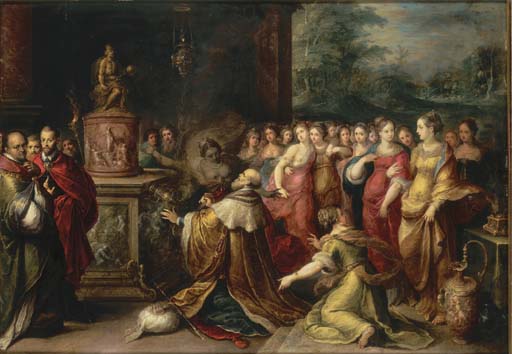
In I Kings 11:4-8, we read how these women turned Solomon away from God. He did the unthinkable – building altars for their foreign gods, and much worse. These gods included the abominable Ashtoreth, Molek, and Chemosh. He built places of worship for these gods at the high places of the land. These were gods who demanded child sacrifice. Horrific.
The passage describes Solomon’s acts as evil in the eyes of the Lord. It isn’t exaggerating.
God’s Anger Burned against Solomon
It is hard to imagine the Solomon we saw at the dedication of God’s holy temple turning his back on God like this – for women. The same God who’d granted Solomon this great empire, all this wealth, and such deep wisdom.
In I Kings 11:9-13, we read about the consequences of Solomon’s actions. God told Solomon that he would rip the kingdom away from him, and give it to one of his subordinates. God said that he wouldn’t do it during Solomon’s lifetime because of promises made to Solomon’s father, King David. Because of David’s faithfulness, he’d leave one tribe to Solomon’s descendants.
Interpretation
Author
The author of 1 Kings and 2 Kings might have been the prophet Jeremiah, but there is no certainty of that.
Genre
Historical narrative. I and II Kings record the monarchical succession of the leaders of Israel and Judah, seeking to provide a detailed factual description of events. The writer is a historian, a theologian, and a storyteller.
Takeaways
Solomon’s defiance started small
Solomon knew better than to take all those women as his own. Was he driven by lust? By pride? Was it fun to wow other men with his many women? A symbol of his power? We can’t know for certain all his motivations. But it was defiance to God, who had forbid multiple wives for kings (Deuteronomy 17:16) and had especially prohibited marrying from foreign cultures who worshipped other gods.
In Solomon’s mind, perhaps this was a harmless sin. One where nobody got hurt. I won’t let her sway me to her foreign gods, he might have thought. Just a few wives, like my father, David. But then a few became many.
Small sins became big sins
We’ve already described in Observations how the women turned Solomon’s heart to these foreign gods. As a revered king, he was especially responsible, because he led the people astray. And this wasn’t just innocent idol worship. This worship involved horrendous acts that were the opposite of harmless sin.

This is how Satan works. He tells us that it’s a small sin that doesn’t hurt anyone. Then he makes us feel guilty. Unworthy of God’s love. So why not just keep sinning, regardless of how big?
Be careful who we marry
The Bible says that the wives led Solomon astray. Quotes in our passage like these make it clear:
- Solomon held fast to them in love
- His wives led him astray
- His wives turned his heart after other gods
- On the east hill of Jerusalem, Solomon built a high place for the detestable Chemosh of Moab…he did the same for all his foreign wives.
Let’s be clear that it isn’t the marrying of a foreigner that was the problem – it was the marrying of women who didn’t share Solomon’s faith in the one true God. We may not have the wisdom of Solomon, but we would be acting wiser than him to marry another believer.
What happened to Solomon’s wisdom?
Solomon was the wisest man in the world. He wrote Proverbs! He knew better. If he’d just followed to his own advice, he wouldn’t have fallen away.
Wisdom alone isn’t enough. Knowing better isn’t enough. In Solomon’s case, I believe pride got in the way. He became enamored with his own success. He had the temple, the palace, the land he governed – why not the women too? Eventually, he gave into their wiles.
Correlation
Do not be unequally yoked
2 Corinthians 6:14 warns us not to be “unequally yoked” with unbelievers. Essentially, this is a warning against marrying unbelivers. It will cause strife in a marriage and has the potential to lead one astray like it did Solomon. To study the meaning of this phrase in more detail, check out this link: unequally yoked.
Nehemiah 13:23-26 warns the Hebrews who returned to Jerusalem from captivity about intermarrying. Verse 26 specifically bemoans the fall of the great King Solomon, describing how Solomon was loved by God, only to be led into sin by foreign women.
Little sins
I Corinthians 5:6 – this verse is in a passage about boasting, not marrying an unbeliever. But the analogy of a little yeast spreading through an entire loaf of bread is a good one. A little boasting can lead to gossip which can lead to divisions in a family of believers. Boasting is an example of another small sin that really isn’t that small. As the yeast spreads, the sin multiplies.
And didn’t Solomon’s sin likely begin with boasting? With pride? He was proud of his kingdom and his wealth. He wanted to boast about his many exotic wives, too. And so the yeast began to spread.
James 2:10 makes it clear that there are no little sins. Stumbling to uphold just one command makes us guilty of them all.
Application
Generic Applications
- There is no prohibition about hanging out with sinners – Jesus was criticized for such. But dating and marrying an unbeliever is another matter. When seeking a spouse, ask this critical question: Will he/she draw us closer to Christ or away from Christ?
- Let’s not allow small sins to take root in our lives. Don’t allow that yeast to take control.
- Solomon was an older man when he turned from God. Let’s recognize that wisdom is not enough. And Satan will never stop trying to turn our hearts. Remain vigilant! Do not allow foolish pride to guide our decisions.
Personalize it
Let’s take an honest look at our hearts. Is there some small sin hidden inside that nobody knows about? Well, God knows. Rather than feeling hopeless and guilty, just give it to God. If you’ve tried that and reverted, give it to God again! He will not turn from true repentance.
Bible study methodology adapted from Searching the Scriptures with permission from Tyndale House:
Swindoll, Charles, Searching the Scriptures. Tyndale House Publishers, 2016.
Leave a Reply